


We often think of negotiations as battlegrounds for words. Carefully chosen language. Crafted responses. Bulletproof arguments. But what if I told you that in 2025, the most critical part of a negotiation isn’t what you say it’s what you don’t say?
Or more accurately: it’s what your cursor, your timing, and your silence are saying instead.
Welcome to the world of digital body language in negotiations.
In face-to-face meetings, we rely on posture shifts, hand gestures, and microexpressions to read the room. But in Zoom calls, Slack threads, email chains, or proposal review software? That language has gone underground. And unless you know where to look, you’re missing half the conversation.
Today, we’ll unpack how to recognize and read digital body language in negotiations and why it’s the secret sauce in your sales process and sales communication arsenal.
Why Reading Body Language in Negotiations Just Got Harder (and Smarter)
Once upon a time, you could walk into a negotiation and read the room like a novel. Crossed arms? Defensive. Raised eyebrows? Skeptical. Tapping fingers? Impatient or just too much caffeine.
But now? Welcome to the world of Zoom calls, Slack threads, and proposal software dashboards. Where eye contact has been replaced by screen glare, and your best shot at reading the room is interpreting a three-dot typing bubble.
According to a survey, a whopping 74% of B2B negotiations now happen in remote or hybrid environments (source). That means you’re making six- and seven-figure decisions without ever shaking a hand or seeing a real-time reaction.
So how do you read the room when the room is a browser tab?
You learn to read digital body language.
What Is Digital Body Language?
Digital body language is the new frontier for the modern sales professional. It’s not about facial expressions it’s about behavior patterns. It’s the subtle (and not-so-subtle) signals your prospect sends through clicks, delays, and digital breadcrumbs.
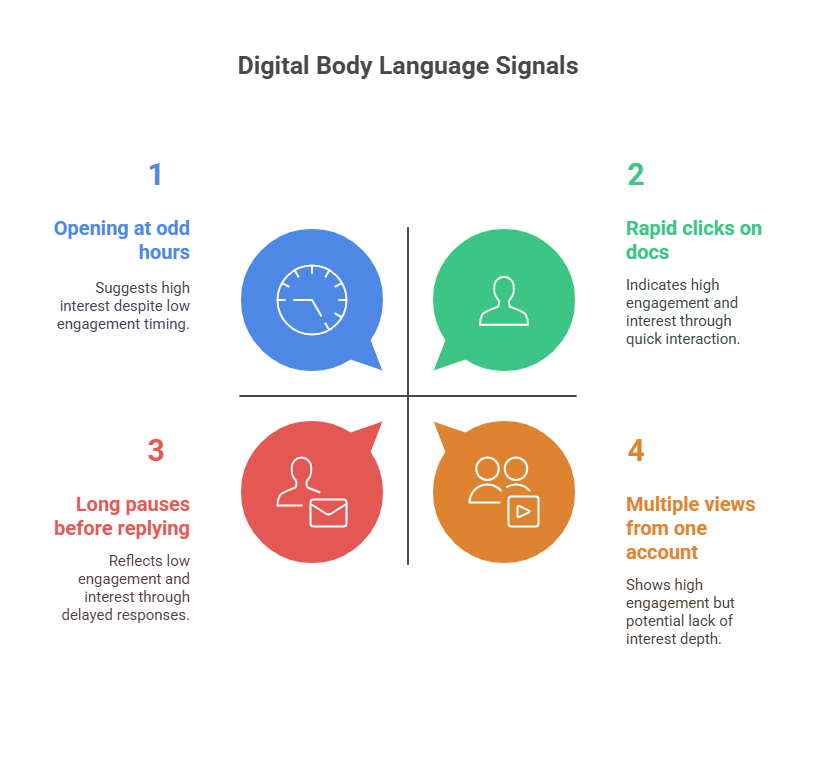
Here’s what to look for:
| Digital Cue | What It Might Mean |
|---|---|
| Long delay between email replies | They’re disengaged, overwhelmed, or shopping around. |
| Multiple proposal views in a short time | Internal discussions are heating up. You’re being seriously considered. |
| Edits to shared documents | They’re engaged—but also trying to protect their interests. |
| Hover data in proposal software | They’re curious, but not ready to commit. |
| Viewing the pricing section multiple times | They’re evaluating ROI—or preparing to negotiate. |
Each of these is a digital “tell.” And just like in poker, the best players aren’t the ones who bluff the best—they’re the ones who read the table the best.
Why This Matters in the Sales Process
In the traditional sales process, you could adjust your pitch based on how someone physically reacted. Now, you have to rely on data, timing, and tone.
And here’s the kicker: most sales teams haven’t caught up. They’re still treating digital interactions like analog ones. But the sales professionals who win in this new era are the ones who treat every click, pause, and edit like a conversation.
Because it is.
Reading Between the (Chat) Lines: The Role of Sales Communication in Digital Negotiations
Let’s say a client raises an objection in a chat or email:
“We’re not sure about the 12-month commitment.”
Your instinct? Respond immediately. Reassure them. Defend the value. Maybe even throw in a discount.
But here’s the thing: top-performing sales professionals don’t jump in right away.
Why? Because that pause creates space. And in digital environments, space signals confidence.
Think about it. When someone replies instantly, it can feel reactive—like they were waiting, twitchy-fingered, to pounce. But when someone takes a beat, it feels thoughtful. Measured. Like they’re considering, not scrambling.
Sales Communication Is a Performance, Even Digitally
In digital negotiations, every message is a micro-performance. Your tone, your punctuation, your timing—they all send signals.
Let’s break it down:
| Digital Behavior | What It Signals |
|---|---|
| Instant replies | Eagerness, maybe desperation |
| Deliberate pause | Confidence, thoughtfulness |
| Short, clipped responses | Disinterest or defensiveness |
| Clear, structured replies | Authority and clarity |
This is why sales communication is more than just messaging—it’s choreography. You’re not just typing. You’re performing trust.
The Art of Hover Tracking: Reading Proposal Interactions Like a Pro
Let’s talk about one of the most underused tools in your sales process: hover tracking.
Modern proposal software like Fresh Proposals can show you:
- Which sections a prospect hovered over
- Which pages they skipped entirely
- Where they paused
- Whether they shared the proposal
If they hover over pricing for 3 minutes but skip the About Us section, what does that tell you? They’re not here for your story they’re here to do math.
Use that insight to tailor your follow-up:
“Noticed you spent time on the pricing structure—happy to unpack how we built that model.”
Now, you’re not just reading body language. You’re responding to it. That’s a different league.
Ghosting, Reframed: When Silence Is a Signal (Not a Rejection)
Let’s talk about the digital elephant in the Zoom room: ghosting.
You’ve had the calls. The demos. The proposal is in their inbox. You even threw in that clever subject line “Just floating this to the top of your inbox like a good croissant.” And then… silence.
No reply. No feedback. Just the cold, digital void.
It feels like a door slammed in your face. But here’s the truth: in today’s sales process, silence doesn’t always mean “no.” Sometimes, it means “not yet.” Or “I’m overwhelmed.” Or “Legal is still reading page 14 of your MSA.”
In other words, silence is a signal. And great sales professionals know how to read it.
The Psychology of Ghosting in B2B Sales
In personal relationships, ghosting is often avoidance. In B2B sales, it’s usually uncertainty. Your buyer might be:
- Waiting on internal approvals
- Juggling shifting priorities
- Nervous about commitment
- Just plain busy (hello, Q4 chaos)
So instead of panicking, ghosting is your cue to pivot your sales communication strategy.
Decoding the Silence: A Practical Guide
| Duration of Silence | Possible Interpretation | Suggested Response |
|---|---|---|
| < 2 days | Normal processing or internal alignment | Light check-in with added value (e.g., “Thought this case study might help your team.”) |
| 3–5 days | Potential roadblocks or de-prioritization | Re-engage with social proof or a revised timeline (e.g., “Here’s how a similar client got buy-in.”) |
| 1 week+ | Likely reconsidering or disengaged | High-stakes value email or escalation (e.g., “Before I close the loop, I wanted to share one last idea tailored to your goals.”) |
This isn’t about chasing. It’s about strategic re-engagement. You’re not begging you’re guiding.
How to Pivot Without Sounding Desperate
- Lead with value, not guilt
Avoid “Just checking in…” Instead, offer something useful: a new insight, a relevant article, or a fresh idea. - Use social proof
“Another client in your industry had similar concerns—here’s how we helped them move forward.” - Create a soft exit
“If priorities have shifted, no worries—just let me know if it makes sense to revisit later.”
This gives them permission to respond honestly, without feeling cornered.
The Spreadsheet Analogy: Making Sense of Digital Noise
Think of your negotiation like a giant spreadsheet.
The left-hand column is what’s said aloud. The right-hand column is what’s actually meant.
Reading body language in negotiations—especially digital ones—means always reconciling those two columns.
Client says: “We’re still reviewing.”
Digital cue: No document opens in 7 days.
Translation: They’ve deprioritized you. Time for a compelling case study or deadline reset.
You can’t always believe what you’re told. But digital body language? It doesn’t lie.
Secondary Signals
In B2B negotiations, you’re rarely talking to one person. You’re negotiating with a shadow committee.
How do you spot them?
-
Multiple IPs or devices viewing your proposal
-
Comments from someone not in the meeting
-
Sudden questions that feel legal or technical
These are clues that more people are involved than you’re seeing.
Adjust your language. Frame your value for a wider audience. Start answering questions they haven’t even asked yet.
That’s sales communication with x-ray vision.
Challenges You’ll Face in Digital Negotiations
Let’s break down the most common challenges in reading digital body language during negotiations and how to solve them like a pro.
Challenge #1: Lack of Real-Time Feedback
The Problem:
You used to rely on nods, eye contact, and the occasional awkward laugh. Now, you’re left staring at a blinking cursor and wondering if they’re thinking or just refilling their coffee.
The Solution:
Use tools that give you real-time visibility. Proposal software with live view notifications, Slack integrations, or CRM alerts can tell you when someone’s engaging with your content.
“Oh look, they’re viewing the pricing section again. Time to follow up with a value reminder.”
It’s not stalking it’s strategic sales communication.
Challenge #2: Misreading Intent from Short Replies
The Problem:
You get a message that says, “Let me check internally.” Is that a stall tactic? A soft no? Or are they actually checking?
The Solution:
Ask clarifying questions. Don’t assume. Instead, respond with something like:
“Totally understand—just to make sure I’m supporting you the right way, is there anything I can prep for your internal review?”
This opens the door for honest feedback without sounding pushy.
Challenge #3: Ambiguity from Multiple Stakeholders
The Problem:
You’re talking to three people. One’s excited, one’s silent, and one keeps forwarding your emails to Legal. Who’s actually driving the decision?
The Solution:
Summarize discussions regularly and request confirmation from all parties.
“Just to recap, it sounds like we’re aligned on X and Y. Can I confirm that with the team before we move forward?”
This keeps everyone on the same page and keeps you from chasing ghosts.
Challenge #4: Over-Reliance on Software Cues
The Problem:
You saw they hovered over the pricing table for 12 minutes. Now you’re convinced they’re ready to buy. But… they’re not.
The Solution:
Use software cues as signals, not gospel. Combine them with intuition, past experience, and context. Remember: data is a compass, not a map.
5-Step Framework to Digital Body Language Mastery
You knew I’d break this down, right?
-
Notice: Track behavior. Use tools. Collect the signals.
-
Name: Label what each digital cue likely means.
-
Narrate: Reframe the signals in your follow-up language.
-
Navigate: Adjust your offer, tone, or timeline accordingly.
-
Nurture: Don’t just negotiate. Build long-term trust through relevant communication.
Simple? Yes. Easy? Not remotely. Worth it? Every time.
Conclusion: Make the Invisible, Visible
Most people miss the deal because they’re watching the words and missing the signals.
Reading body language in negotiations—especially digital body language—is your edge. It’s your sixth sense. It’s how you know when to speak, when to pause, and when to throw in that one perfect stat that changes the game.
So, the next time you’re staring at a quiet inbox or a paused Zoom screen, remember:
The conversation never stopped. You just have to listen differently.



0 Comments