

You’ve just had a great call with a potential client. They’re excited. You’re excited. You promise to send over a proposal “by end of day.”
But then…
-
You’re digging through old folders for a template that’s almost what you need.
-
You’re copy-pasting from previous documents, hoping you didn’t leave in the wrong client’s name.
-
You’re fiddling with pricing tables that don’t quite add up.
-
By the time it’s ready, it’s tomorrow.
That small delay? It’s invisible to you but loud to your prospect. It whispers: “They’re disorganized.” And that’s enough to make them second-guess signing.
This is where software for proposals comes in. Not as “yet another tool” you have to learn, but as a silent, behind-the-scenes sales partner that keeps deals moving, your brand looking sharp, and your sanity intact.
Why “Good Enough” Proposal Processes Cost You More Than You Think
The faucet is dripping. Drip. Drip. Drip.
For years, it’s been doing its thing. It’s not a flood, it’s not a burst pipe, so you’ve learned to tune it out. You’ve convinced yourself that because the water still comes out when you need it, the small, rhythmic leak is no big deal. It’s “good enough.” This is the same silent, insidious logic that governs so many business processes, especially when it comes to creating and managing proposals.
You’ve been sending proposals via Word docs or PDFs for years, and it’s tempting to think: If it’s not broken, why fix it? But “not broken” isn’t the same as “working well.” Your “good enough” process isn’t a neutral state; it’s an active drain. It’s a series of small, nearly invisible inefficiencies that compound over time, wasting gallons of time, money, and opportunity.
Let’s dissect these hidden costs, because they’re far more significant than you realize.
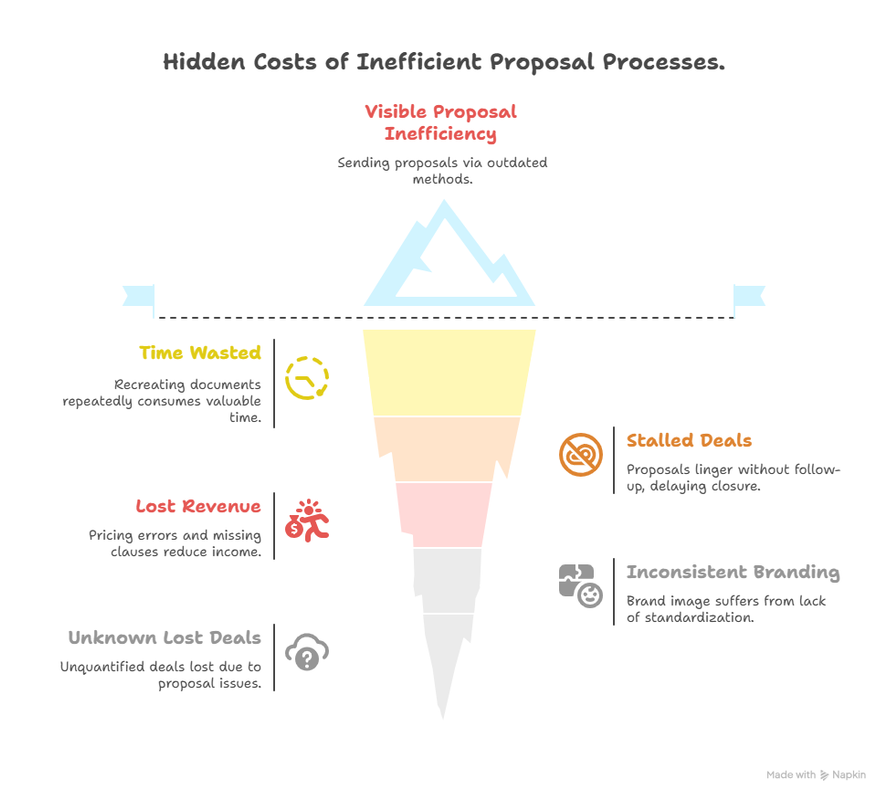
1. The Sisyphus Syndrome: Time Wasted Recreating the Same Documents.
Every time a new prospect comes in, you roll the same boulder up the same hill. You open a previous client’s proposal—the “template”—and you begin the tedious, error-prone dance of find-and-replace. You change the name, the date, the scope, the pricing. But you inevitably miss something. A single misplaced name or a forgotten date instantly signals to your prospect that you are a vendor, not a partner. This isn’t scalable; it’s a time sink. That hour you spend on each proposal isn’t just an hour—it’s an hour you could have spent talking to another potential client, refining your product, or simply thinking.
2. The Black Hole of the Inbox: Deals Stalled Without Follow-up.
You hit “send” and then… silence. You have no idea if your email was even opened, let alone if the proposal was read. Did they like the pricing? Were they confused by a certain section? Without real-time analytics, your follow-up is a shot in the dark. It becomes an awkward, “Just following up to see if you had a chance to look at this?” email that provides no value. A deal that stalls is a deal that dies. Your “good enough” method leaves you in the dark, unable to be proactive, unable to provide the right information at the right time.
3. The Leaky Bucket: Lost Revenue from Errors.
Human error is inevitable. In your “good enough” process, a simple copy-paste mistake can change a price from $5,000 to $500. A forgotten clause about a payment schedule can cost you thousands in cash flow down the line. These aren’t minor hiccups; they’re catastrophic failures. They erode your margins and can even force you to take on less profitable work just to save face. The upfront cost of a good software for proposals seems steep until you tally up the cost of a single, avoidable mistake.
4. The Inconsistent Brand.
Your proposal is a physical manifestation of your brand. If you’re using a mix of outdated templates, different fonts, and inconsistent formatting, you’re not projecting a unified, professional image. You’re sending a message that you’re disorganized and not paying attention to the details. A company that presents itself inconsistently is perceived as less trustworthy and less professional. The “good enough” approach chips away at the very foundation of your brand.
And here’s the kicker, the truly terrifying part: you probably don’t even know how many deals you’ve lost because of it. The client who chose your competitor after seeing a typo in your proposal never told you. The prospect who was overwhelmed by your clunky, hard-to-read document simply went silent. The deals you lost in this silent, invisible way are the true, immeasurable cost of “good enough.” It’s not a flood, it’s a slow leak, and it’s costing you more than you can possibly imagine.
The Proposal Bottleneck: The Silent Killer of Sales
Sales leaders love talking about “top of the funnel” activities — lead gen, cold calls, social outreach. But the truth is, deals don’t fall apart because of bad leads. They often crumble in the middle, during the proposal stage.
Signs you’re stuck in the bottleneck:
-
It takes you more than a few hours to prepare a proposal.
-
You don’t know if the client opened it, or how long they looked at it.
-
You can’t easily adjust pricing or terms without starting over.
-
You’ve sent “final” versions… multiple times.
Here’s what it looks like side-by-side:
| Manual Process | Proposal Software | |
|---|---|---|
| Creation Time | 2–4 hours | 15–30 minutes |
| Branding | Inconsistent | Consistent, on-brand every time |
| Pricing | Manual updates prone to errors | Auto-calculated, error-free |
| Tracking | None | See when, where, and how long they viewed |
| Signatures | Print-scan-email or third-party e-sign tools | Built-in, instant |
What Software for Proposals Actually Does (Beyond Sending PDFs)
A dedicated software for proposals is not just a glorified PDF creator. If you think it’s a fancy version of Microsoft Word, you’re missing the point entirely. It’s a sales enablement platform—a strategic tool designed to help you move from “document sent” to “deal closed” with fewer headaches and less friction. It’s the difference between sending a message in a bottle and having a direct, two-way satellite communication system.
So, what are these systems actually doing?
At its core, it’s all about a seismic shift in how you work. Instead of spending hours on manual tasks, a good proposal management software provides a suite of core capabilities that save you time and provide you with a powerful advantage.
Automation is just the beginning. Imagine having a library of pre-approved, on-brand templates, each one a perfectly crafted Lego set of content blocks. When a new prospect comes in, you’re not starting from a blank page. You’re simply snapping together the right pieces: the pricing, the case study, the specific services they need. This isn’t just about speed; it’s about consistency. It ensures every proposal looks and feels like it came from the same professional, reliable source.
But the real magic happens after you hit send. This is where real-time tracking gives you a kind of X-ray vision for your sales process. You’ll know the precise moment your client opens, reads, and signs the proposal. You’ll see which sections they’ve spent the most time on, which tells you what’s most important to them. This isn’t just data; it’s a roadmap for your next conversation. When a client spends five minutes on the pricing page and then closes the document, you know exactly what to address in your follow-up call.
And let’s not forget the crucial, final step: getting a signature. With built-in e-signature capabilities, there’s no need to use a separate tool or make the client print, sign, scan, and send a document back. This frictionless process removes a major point of delay. It turns a clunky, multi-step chore into a single, elegant digital handshake.
Finally, a powerful software for proposals doesn’t operate in a vacuum. Its true value is unlocked through its integration with your existing ecosystem. It syncs with your CRM, so you’re not manually updating contact information. It connects to your accounting platforms like QuickBooks or Xero, so that accepted proposal can automatically kick off the invoicing process. It turns a series of disconnected, manual tasks into a single, well-oiled machine.
For an accounting firm, sending an automated engagement letter isn’t just about being faster—it’s about professional brand positioning. When that letter is delivered instantly, branded consistently, and signed without delays, you position your firm as a reliable, process-driven partner from day one. You’re not just sending a document; you’re sending a signal: “We’ve got this handled.”
The ‘Am I Ready?’ Checklist: Is Your Process Costing You?
It’s easy to get comfortable with the way things are. We all do it. The manual processes that once felt manageable slowly become a kind of background noise—a low-level hum of inefficiency that we just learn to live with. But that hum isn’t harmless; it’s the sound of lost time, missed opportunities, and a brand that isn’t living up to its potential. The question isn’t whether your current method is “working,” but whether it’s working for you.
So, how do you know when it’s time to stop tolerating the “good enough” and make a real change? Here’s a simple checklist to help you figure it out. If you check three or more of these boxes, the friction you’re feeling is real, and it’s likely costing you more than you think.
-
You’ve ever sent a document titled
Proposal_Final_v4_REALFINAL.docx. This is the universal sign of chaos. It’s the digital equivalent of a file cabinet bursting at the seams. It means your process is a reactive mess, not a predictable system. It signals that version control is a daily struggle, and the risk of sending the wrong document to the wrong client is uncomfortably high. -
You waste more than 2 hours per proposal. If you’re spending your valuable time on repetitive tasks like reformatting, searching for the right content, or manually creating a PDF, you’re not selling—you’re doing administrative work. This time could be spent on higher-value activities: building relationships, strategizing, or engaging with new prospects. Your time is your most precious resource, and this process is a thief.
-
You manually re-enter client info into multiple systems. The disconnect between your CRM, your proposal template, and your accounting software is a time-suck and a source of potential errors. This manual entry is a bottleneck that slows down your sales cycle and introduces unnecessary risk.
-
You don’t know which proposals are sitting unopened. This is the black hole of the sales process. You send a document and then you wait, completely in the dark. Without tracking, your follow-up is based on hope, not data. You’re guessing who to call and when, missing critical opportunities to engage with hot prospects.
-
Your competitors are sending interactive, trackable proposals—and you’re not. You are not competing in a vacuum. Your clients are seeing what’s possible, and when they compare your static PDF to a competitor’s dynamic, personalized, and easy-to-sign proposal, you are at a disadvantage. This isn’t a matter of being trendy; it’s a matter of meeting modern expectations.
For specific industries like accounting, these pain points become even more critical. If you find yourself manually sending engagement letters, chasing clients for signatures, or if your staff spends billable hours on admin tasks instead of client work, you are actively eroding your firm’s profitability and professionalism. The cost of a few extra hours a week across your team adds up to thousands in lost revenue and a brand that feels less polished than it could be.
If this checklist resonates with you, it’s a clear signal that your current process is no longer serving you. It’s time to stop patching the old system and start building a new, more effective one with dedicated proposal software.
The Business Impact: From Proposal Creation to Closed Deals
A powerful proposal tool doesn’t just accelerate the creation of documents; it fundamentally changes your sales cycle, speeding up the process from initial contact to a signed agreement. It’s a strategic shift that transforms a static document into a dynamic conversation starter, directly impacting your bottom line.
The key to this impact lies in moving beyond a “send and pray” approach. Instead, software for proposals gives you a level of insight and control that was previously impossible with traditional methods.
Actionable Insights for Smarter Follow-up
Knowing when to follow up is a game-changer. Imagine seeing a real-time notification that a prospect just opened your proposal for the third time and is spending five minutes on the pricing page. You don’t need to guess about their interest level or send a generic “just checking in” email. You know exactly where they are in their decision-making process. This allows you to time your follow-up perfectly, with a conversation tailored to their specific questions and concerns. It transforms a cold call into a warm, relevant engagement.
Data-Driven Decisions, Not Guesswork
Your proposal process becomes a powerful source of data. By tracking key metrics—like how often proposals are viewed, which sections get the most attention, and the final win rates—you can see what’s truly working. You can A/B test different pricing models, content layouts, and even video introductions to see which ones lead to the highest conversion rates. This kind of data allows you to optimize your sales strategy, moving away from guesswork and toward a proven, repeatable process for success.
Professionalism is Your Competitive Edge
A seamless proposal process signals a seamless business. When a client receives a branded, easy-to-navigate proposal that can be signed with a single click, it builds immediate trust. They equate this level of professionalism with the quality of service they can expect to receive. This isn’t a small detail; it’s a powerful signal that your company is organized, detail-oriented, and easy to do business with.
It’s no surprise, then, that businesses using proposal management software close deals 18–35% faster than those who don’t. This isn’t due to some mystical force within the software. It’s because it systematically removes all the small points of friction—the manual data entry, the version control headaches, the opaque follow-up process—that slow down a client’s decision. By making it easy for your clients to say “yes,” you simply get to the “yes” faster.
When Proposal Software is Overkill (Yes, Really)
Let’s be fair — if you send fewer than 5 proposals a year, or all your deals happen face-to-face in a single meeting, you might not need it yet.
But most businesses hit a tipping point. Suddenly you’re juggling:
-
Multiple team members creating proposals
-
Remote clients in different time zones
-
Pricing that changes by project or season
-
Integrations with billing, CRM, or workflow tools
At that point, not using proposal software is like running a landscaping company with nothing but a pair of scissors. Sure, you can trim a hedge. But scaling? Forget it.
Fresh Proposals: Built for Modern Sales Teams

Fresh Proposals isn’t just “software for proposals” — it’s proposal management without the chaos.
Why sales leaders and accounting firms choose it:
-
Automate everything: From proposal creation to assigning work items in Karbon.
-
One-click integrations: Connect with QuickBooks, Xero, and other accounting tools.
-
Track the entire funnel: From first view to final signature.
-
Automated engagement letters: For accounting firms, send and sign without the back-and-forth.
Example:
An accounting firm used to spend 2–3 days preparing and chasing engagement letters. With Fresh Proposals, they send them instantly after a discovery call, track when clients open them, and get signatures in hours, not days.
The result?
-
70% less admin time on proposals
-
Faster revenue recognition
-
Happier clients from the very first interaction
Decision Time: What’s the Cost of Waiting?
Every week you stick with the old way is another week you risk:
-
Losing deals to faster-moving competitors
-
Wasting hours on work that software could automate
-
Looking less professional than you actually are
And here’s the truth — software for proposals doesn’t just save time. It changes the perception of your business in the eyes of your prospects.
If you want your proposals to reflect the same professionalism and speed you promise in your services, the right time isn’t “later.”
It’s now.
Key Takeaways
-
If proposals take more than an hour, you need a better system.
-
Tracking = smarter follow-ups = faster closes.
-
Automation frees your team for higher-value work.
-
For accounting firms, automated engagement letters are a game-changer.
-
Fresh Proposals gives you all of this in one place — no chaos, no duct-taped solutions.
Ready to see what modern proposal management feels like?
Try Fresh Proposals today and start closing deals faster — without the proposal headaches.


0 Comments