

Let’s imagine, for a moment, your sales team is running a relay race. A global relay race. The baton? A critical sales proposal for a massive, international client. The runners? Your sales rep in Berlin, the legal eagle in London, the finance wizard in Singapore, and the technical expert in Seattle. Each runner needs to touch the baton, add their piece, and pass it on. Sounds straightforward, right?
Except, in many organizations, this “relay race” looks more like a chaotic scavenger hunt. The Berlin rep emails a draft to London, who makes changes and emails it to Singapore. Singapore then discovers an outdated pricing clause, forwards it back to Berlin, while also emailing Seattle for technical sign-off. Suddenly, there are five different versions of the “baton” flying around, each with different markups, comments, and approvals (or lack thereof). Someone inevitably drops the baton – or worse, sends the wrong baton to the client. This isn’t just inefficient; it’s a direct threat to your bottom line, your brand reputation, and your ability to scale. The truth is, managing global proposal workflows with multistakeholders is fundamentally broken in many companies, leading to lost deals and immense frustration.
Why Multistakeholders Make Proposal Chaos Inevitable?
Have you ever tried to plan a group dinner with more than three friends? Everyone has an opinion: Italian? Thai? “I’m gluten-free, but only on Tuesdays.” “Can we go somewhere with vegan options for Sarah, but also a good steak for Dave?” What starts as a simple desire for shared nourishment quickly devolves into a flurry of messages, compromises, and eventually, often, exasperated silence as someone gives up and orders takeout alone.
Now, apply that delightful chaos to your sales process, particularly when crafting complex business proposals. When multiple multistakeholders from legal and finance to product and senior management need to review, edit, and approve a single document, you’re not just adding extra eyes; you’re introducing friction at every turn. It’s not a matter of if chaos will ensue, but when and how bad. The very nature of multistakeholder involvement, without the right tools, makes proposal chaos inevitable.
The Domino Effect of Disconnected Feedback
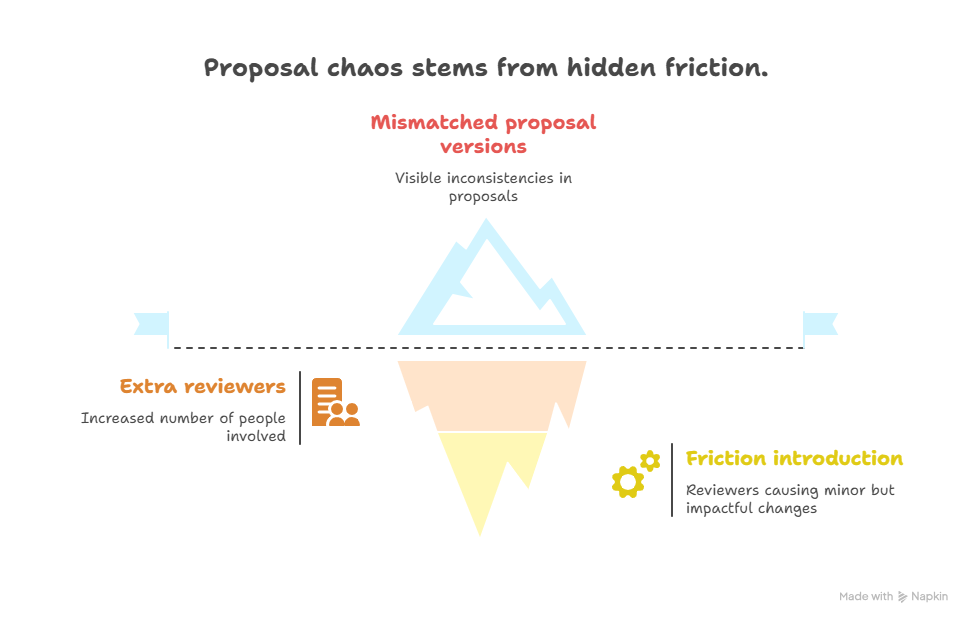
Every additional reviewer, every extra set of eyes, brings their unique perspective and, often, their preferred way of providing feedback. This is where the domino effect of disconnected feedback begins, turning a straightforward document into a patchwork quilt of conflicting suggestions and unintended errors.
Consider this common scenario:
- Someone changes a number: The Sales Manager might update a pricing figure based on a last-minute client negotiation.
- Someone else tweaks formatting: Simultaneously, the Marketing team (bless their hearts, they just want it to look good) might adjust the font, spacing, or image placement, unaware of the sales manager’s critical update.
- Now you have mismatched versions: The original document is now bifurcated. One copy has the correct price but wrong formatting. Another has the perfect formatting but outdated numbers. Which one is sent to the client? This isn’t just a hypothetical. When multistakeholders operate in silos, using disparate tools for feedback, inconsistencies are not an exception; they are the rule.
The problem isn’t the reviewers themselves; it’s the lack of a centralized, unified system for their input. Feedback gets scattered across a digital landscape: comments buried deep in email threads, urgent notes pinging on WhatsApp, track changes in a downloaded Word document, or detailed instructions logged in a Jira ticket. There’s no single source of truth for the latest version or the cumulative feedback. This fragmentation means:
- Lost Feedback: Crucial suggestions or mandated changes simply disappear into the digital ether.
- Redundant Work: Multiple people might make the same change, or worse, conflicting changes, forcing someone to manually reconcile them.
- Approval Gridlock: Who has the final say? Has everyone seen the latest version? The lack of alignment stalls the entire proposal process.
The Stalling Power of “Too Many Cooks”
The old adage, “too many cooks spoil the broth,” applies perfectly to multistakeholder proposal reviews. Each individual, with their specific department’s priorities and legal or financial mandates, acts as a bottleneck if not properly managed.
Fact: 73% of global sales teams report delays caused by multi‑stakeholder review loops. Disconnected feedback across Jira, email chains, WhatsApp nothing aligns.
Think about that for a moment. Nearly three-quarters of sales teams worldwide are literally waiting for internal processes to catch up, costing them valuable selling time and, more critically, losing deals to competitors who can move faster.
This isn’t just about a few hours; it’s about deals dying on the vine because the proposal process couldn’t keep pace with the market. When you have multistakeholders in different time zones, across different departments, all working in disconnected feedback channels (Jira for development, email for sales, WhatsApp for quick chats, Slack for general communication), nothing truly aligns. The proposal bounces around like a pinball, accumulating friction at every touchpoint.
The consequence? Too many stakeholders stall the sale. The client, who likely has options, isn’t going to wait indefinitely while your internal team plays digital hide-and-seek with the latest version. They’ll move on to the competitor who can deliver a professional, accurate sales proposal quickly and seamlessly. The hidden cost here isn’t just the lost deal; it’s the eroded trust, the damaged reputation for efficiency, and the crushing frustration for your sales team.
In essence, while multistakeholder involvement is necessary for robust, compliant business proposals, it’s also the primary engine of chaos when managed manually. The solution isn’t to reduce the number of stakeholders (that’s rarely an option); it’s to transform the environment in which they collaborate.
Core Components of an Expert Global Workflow
So, we’ve dissected the beast of multistakeholder chaos in proposal creation – the time zone tango, the version vortex, the accountability abyss. Now, let’s talk about the solution. What does an advanced, truly expert global proposal workflow look like? It’s not about magic; it’s about architecture. It’s about designing a system that respects the complexities of global teams and diverse multistakeholders, while simultaneously accelerating the proposal process. Imagine building a highly efficient, automated factory floor for your business proposals, where each specialist performs their task precisely, and the product moves seamlessly from one station to the next, ultimately delivering a flawless output.
Precision Pipelining: Role-Based Approvals
At the heart of any expert global proposal workflow lies precision routing. This isn’t just about sending an email to a generic “approvals” inbox. It’s about intelligent, role-based approvals.
Think of it like a specialized assembly line. When a sales proposal reaches a certain stage or meets specific criteria, the system knows exactly which expert needs to review it. For instance:
- One Finance Reviewer: Any proposal exceeding a certain value (say, $50,000) or involving specific financial terms automatically goes to the designated finance approver.
- One Legal Reviewer: If the proposal includes non-standard clauses or is for a client in a highly regulated industry, it’s routed directly to the legal team for compliance sign-off.
- One Regional Sales Manager: For proposals within a specific geographic territory, the relevant regional sales manager gets a notification for their strategic overview and final green light.
Crucially, these approvals can be configured with a specific order. Legal must approve before Finance? No problem. The system enforces the sequence, eliminating guesswork and ensuring no critical step is accidentally skipped by multistakeholders. This focused approach ensures that each reviewer sees only what’s relevant to them, reducing cognitive load and speeding up their decision-making.
The Art of Parallel vs. Serial Reviews: Maximizing Velocity
One of the biggest bottlenecks in traditional global proposal workflows is the serial review process – one person has to finish before the next can even start. An expert workflow understands that not all approvals are created equal, and some can happen concurrently.
- Parallel Review Assignments: Imagine legal and product teams reviewing different sections of the same sales proposal simultaneously. Their feedback might be independent, or their changes might not directly conflict. An advanced system allows for simultaneous reviewer assignments without blocking others. This dramatically cuts down on overall review time, especially when dealing with multistakeholders across vastly different time zones. While Legal is reviewing the compliance clauses in London, the Technical team in Tokyo can be verifying the product specifications.
- Hybrid Approaches: Some complex approvals might require a serial start, followed by parallel reviews, and then a final serial sign-off. The best systems offer the flexibility to design these nuanced paths, optimizing for both speed and thoroughness.
This intelligent orchestration ensures your business proposals aren’t waiting idly in digital queues but are constantly progressing, leveraging the available time of your multistakeholders more effectively.
Forensic Detail: Version Tracking Per Stakeholder
The “version vortex” is a killer. An expert workflow provides version tracking per stakeholder, offering granular insight into every change.
- Attributable Edits: The system logs precisely who made what change, and when. If a specific pricing figure was altered, you know exactly which finance team member did it, and on what date.
- Comment Trails: All comments and suggestions from each reviewer are tied to the specific version and section, creating a clear dialogue history. This eliminates confusion and ensures feedback is never lost, even from geographically dispersed multistakeholders.
This forensic level of detail provides an irrefutable audit trail, crucial for accountability and future process optimization.
Bridging Boundaries: Language Layers for Global Reach
For truly international operations, an expert global proposal workflow embraces linguistic diversity through language layers.
- Localized Introductions: Your sales rep in Brazil can select a localized introduction that resonates culturally, even if the core service descriptions are drafted centrally in English.
- Translated Legal Sections by Reviewer Country: Critical legal clauses can be maintained in a central repository, with pre-approved, certified translations for various jurisdictions. When the legal reviewer in Germany accesses the proposal, they see the German legal section for their review, ensuring multilingual proposal approval is seamless and compliant with local regulations.
This component ensures that while the core offering remains consistent, the delivery is tailored to the local market, fostering better sales communication and improving the overall client experience.
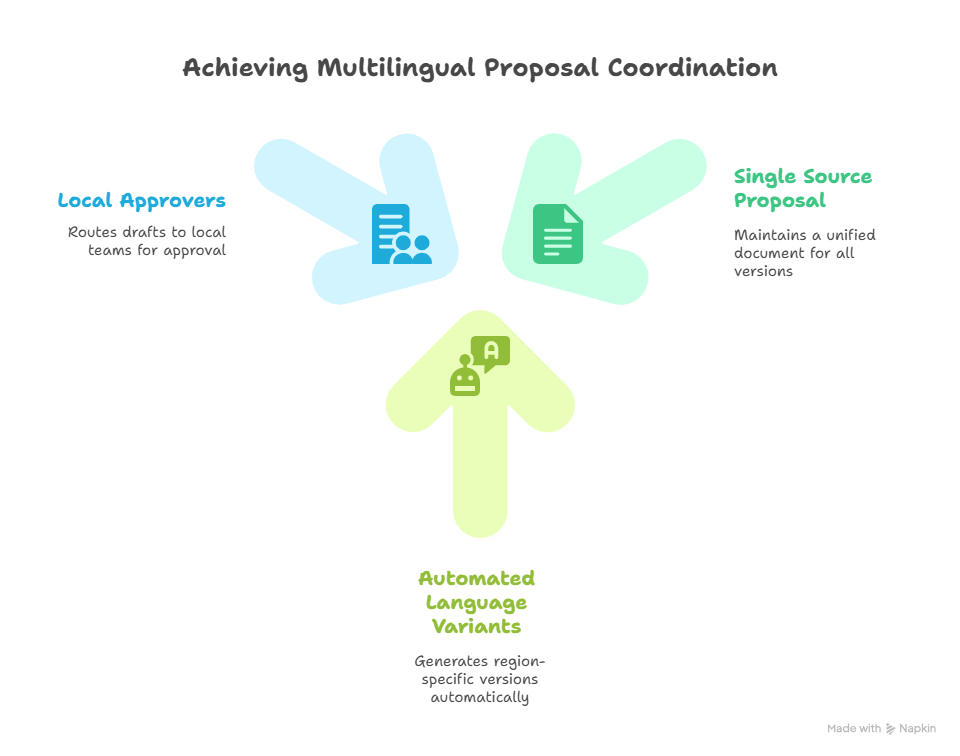
Table: Workflow Design for Multistakeholders
| Stakeholder Role | Workflow Path | Language | Function |
|---|---|---|---|
| Legal Team | Serial Approval | Source | Checks contract terms |
| Finance | Parallel Review | Source | Validates pricing and margins |
| Regional Sales Managers | Parallel & Clone | Local | Add localized offering details |
| External Translator | Parallel Translation | Local | Translates only approved version |
How Analytics Help Keep Multistakeholder Processes Tight
We’ve talked about building an expert global proposal workflow with defined roles and smart routing. But even the best-designed systems can encounter friction. How do you know if your beautiful workflow is actually performing as intended, or if hidden snags are still slowing things down? The answer lies in the unsung hero of modern sales operations: analytics. Just as a doctor uses diagnostics to pinpoint the root cause of an ailment, an advanced global sales proposal software uses data to diagnose and cure inefficiencies in your multistakeholder approval processes. You simply cannot manage complexity you can’t monitor.
Shining a Light on Hidden Bottlenecks
Imagine trying to navigate a dense fog without a map or a compass. That’s what managing a complex multistakeholder approval process without analytics feels like. You know there are delays, but you don’t know where or why. Analytics act as your powerful radar, cutting through the fog and shining a light on precisely where the friction lies.
Modern proposal software collects invaluable data points, transforming abstract delays into actionable insights:
-
How long each stakeholder takes: This is fundamental. The system tracks the exact duration from when a proposal enters a reviewer’s queue to when they complete their action. Is Legal consistently taking three days, while Finance clears proposals in three hours? This metric immediately highlights individual multistakeholder performance and potential training needs or resource allocation issues.
-
Which review cycles drag (legal, pricing, translation): Beyond individual performance, you can see patterns. Are all proposals requiring multilingual proposal approval consistently getting stuck at the translation review stage? Is the pricing committee always the longest hold-up? These insights allow you to identify systemic bottlenecks within specific departments or review types. For global proposal workflows, this is critical for understanding regional or functional challenges.
-
Where proposals get held: This pinpoints the exact stage or specific individual in the proposal process where documents are sitting idle. Perhaps it’s not the review itself that’s slow, but the initial routing or the final sign-off by a senior executive. This gives you laser focus on the precise point of stagnation.
Calibrating for Peak Performance: From Insight to Action
Knowing where the delays are is just the first step. The real power of analytics comes from using these metrics to tighten your multistakeholder processes.
-
Calibrate Deadlines Per Reviewer: Armed with data on average review times, you can set realistic, yet challenging, internal deadlines for each type of multistakeholder. No more arbitrary “approve by tomorrow” requests. You can now tell Legal, “Our data shows these types of reviews take 2.5 days on average; please aim for that.”
-
Send Targeted Nudges: If a proposal is approaching or exceeding its average review time for a particular multistakeholder, the system can automatically send polite, yet firm, nudges. This saves your sales team from awkward chasing and keeps the business proposals moving forward.
-
Rework the Process to Eliminate Stale Loops: The most profound impact comes from strategic process improvement. If analytics consistently show that proposals requiring simultaneous legal and finance review always get stuck because one is waiting for the other, you might refine the workflow to better facilitate parallel collaboration or introduce a preliminary joint review session. If multilingual proposal approval is a constant drag, perhaps investing in dedicated translation resources or integrating AI translation tools becomes a data-backed priority.
By continually monitoring these metrics, you gain an empirical understanding of your proposal process. This isn’t just about efficiency; it’s about competitive advantage. In a world where speed to market can make or break a deal, using analytics to keep your multistakeholder approval processes tight ensures your sales proposals are always moving forward, not languishing in a forgotten inbox. It’s the difference between guessing your way to success and scientifically optimizing your path to winning.
Avoiding Version Overload
Sending proposals as Word attachments leads to multiple threads: “Here’s v3,” “Final_v4,” “Legal_rev2_final.docx.” Not sustainable.
Better is an in-app review: one proposal, edits tracked, notifications triggered—each stakeholder updates in the proposal tool, not via email. Multistakeholders never lose context.
The Analogy That Makes It Click Airport Ground Control
Imagine an airport with flights (proposals) requiring coordination between pilots, ground crew, air traffic control, baggage handlers, and catering. If each staff member works from a different blueprint or track changes independently, disaster.
But if they each have a shared, segmented blueprint—updated in real time—they each execute in harmony. That’s your proposal workflow: shared, segmented, versioned.
Conclusion
The complexity of managing global proposal workflows with diverse multistakeholders is no longer a luxury; it’s the standard for any business aiming to scale internationally. Relying on outdated manual processes is akin to navigating a supertanker with a compass and a paper map – it’s slow, prone to error, and utterly inefficient in today’s digital oceans.
Adopting advanced proposal software like Fresh Proposal software isn’t just about streamlining; it’s about empowerment. It empowers your sales teams to focus on selling, your legal teams to ensure compliance without becoming bottlenecks, and your finance teams to maintain fiscal integrity without endless email chasing. It creates a seamless, auditable, and incredibly efficient process that respects time zones, consolidates versions, and clarifies accountability.
So, if your business proposals are still stuck in a perpetual relay race where everyone’s running in different directions, it’s time to equip your team with the tools to orchestrate a winning symphony. It’s time to leverage technology to turn complex multistakeholder management into a well-oiled machine. It’s about building a future where your global proposal workflows are not just fast, but flawless, ensuring every deal, everywhere, crosses the finish line with precision and clarity. Your global ambitions deserve a process that can keep up.

0 Comments